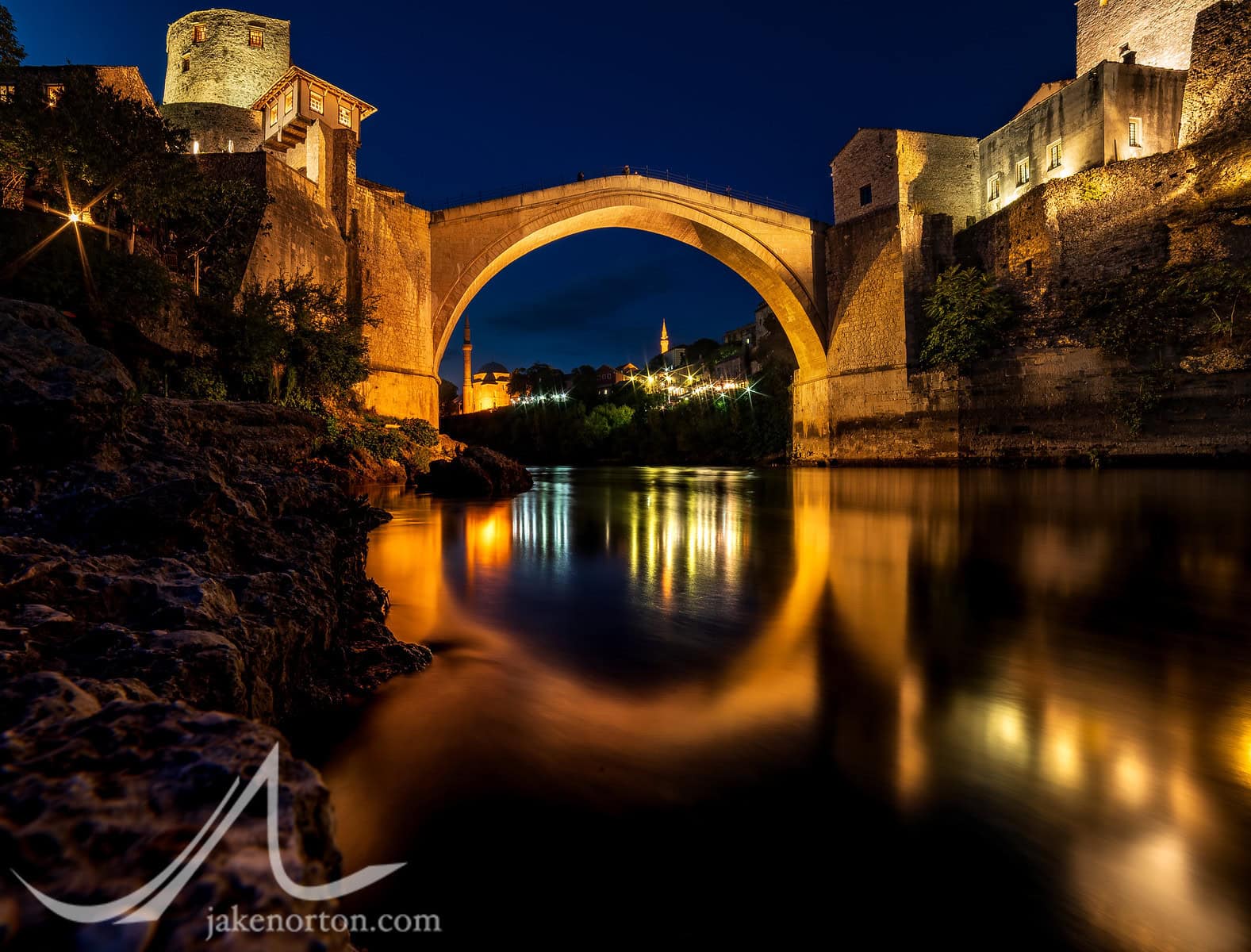
“…[L]ike a rainbow arch soaring up to the skies, extending from one cliff to the other…,” were the words of 17th century Ottoman traveler Evliya Çelebi upon seeing the stunning Stari Most, or “Old Bridge” of Mostar in present-day Bosnia-Herzegovina.
His observations of the physical bridge are spot-on: Commissioned by Ottoman sultan Suleiman the Magnificent in 1557, the bridge has a span of 30 meters (98.5 feet) across the Neretva River while rising to 24 meters (78.5 feet) above the surface. A stone single-arch bridge, Stari Most is an icon of Balkan Islamic architecture, and took about nine years to complete - with the architect, Mimar Hayruddin, working under penalty of death should the project fail.
But, it didn’t fail, and Hayruddin’s “rainbow” not only enabled crossing the Neretva, but also connected eastern and western Mostar, the Christian and Muslim parts of town, neighbor to neighbor, friend to friend, family to family, Muslim and Jew and Catholic and Orthodox. Mostar was then known as a place of connection rather than division, where people of different faiths lived together, worked together, mingled and intermarried, a rainbow of stone building bridges for all.